
Student Learning Styles: Research-Informed Strategies and Practical Tools
Take Learning Style Quiz Online
Get StartedUnderstanding the Landscape of Learning Preferences
Teachers and families want clarity on how different learners absorb, process, and demonstrate knowledge. The topic is bigger than a single label, because learners change with context, task complexity, and motivation, and the same person can prefer different approaches for reading, problem solving, and collaboration. Instead of chasing fads, modern classrooms benefit from a balanced view that respects preferences while centering on evidence-based instruction and rich practice.
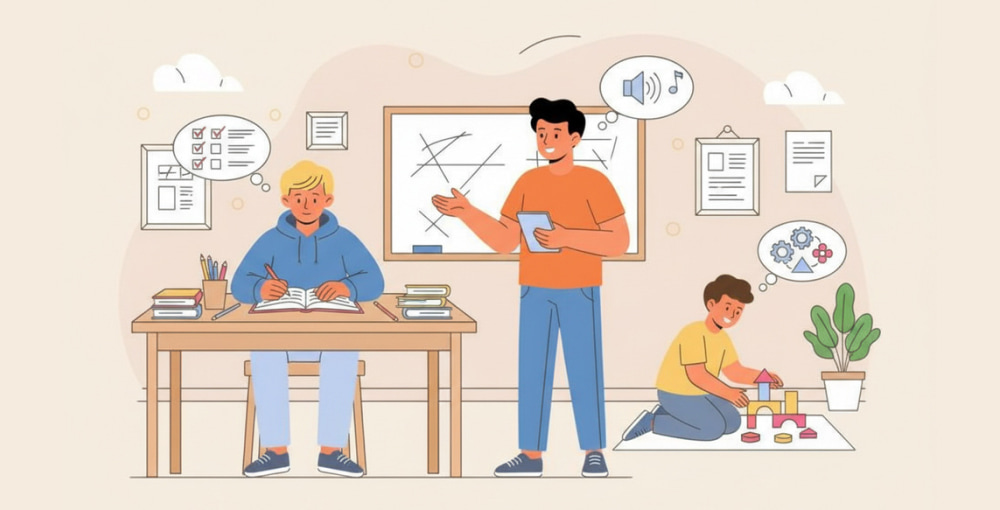
Within classroom dynamics, student learning styles are best approached as evolving tendencies, not fixed identities. That framing helps educators blend multiple modalities, visuals, discussion, writing, and manipulation of concrete materials, so each learner encounters content in varied ways across time. Such variety strengthens transferable skills, reveals misconceptions early, and keeps cognitive load manageable during challenging units.
Another reason to tread carefully is the difference between preference and performance. A learner who “likes” diagrams may still need explicit instruction in decoding complex text, and a peer who loves discussion might benefit from structured note-making. When teachers combine preference data with formative checks, they avoid pigeonholing students and instead design sequences that develop agility: listening closely, sketching ideas, composing explanations, and testing hypotheses all in the same week.
Because context matters, it is helpful to revisit how learners engage when stakes rise, time is short, or concepts are abstract. Observing shifts across these moments uncovers practical patterns: who thrives with models first, who needs a story hook, and who prefers to tinker before reading procedural steps. Those insights fuel targeted scaffolds without limiting students to one pathway.
The Benefits of Aligning Instruction and Feedback
Alignment is about matching the right support to the right moment. When content complexity climbs, the interplay of prior knowledge, modality, and practice opportunities determines whether learners just “recognize” ideas or can independently apply them. Focused reflection on engagement cues, questions asked, persistence shown, and strategies chosen, reveals where instruction should flex and where it should hold firm.
For teachers seeking a starting point, assessing students learning styles can illuminate patterns that complement formative assessment data and performance rubrics. With even a short cycle of gathering preference signals and checking skill growth, instructors can link scaffolds more precisely to goals, such as decoding, summarizing, modeling, or argumentation. Small shifts, dual coding a mini-lesson, chunking practice, or rotating roles in group work, often yield outsized gains in clarity and confidence.
- Design choices feel purposeful when they reduce friction at the exact step where learners typically stall.
- Feedback becomes timely because it references how a learner approached a task, not only the final result.
- Engagement rises when students see multiple entry points and can choose productive first steps.
- Equity improves as hidden barriers, language load, spatial reasoning demands, or sensory overwhelm, are surfaced and addressed.
- Metacognition grows when students can explain which strategies they tried and why those strategies worked.
During unit kickoff, a short reflection can work alongside a concise learning style quiz for students to open conversation about strategies. The key is not to “track” learners but to co-create norms: experimenting with modalities, articulating what helps, and revisiting choices after each milestone. This collaborative cadence makes differentiation feel normal rather than exceptional.
Modalities, Myths, and What Actually Helps
Popular discourse often turns complex cognitive science into catchy slogans. The strongest evidence favors practices like retrieval, spaced review, dual coding, elaboration, and worked examples, all of which can be delivered through multiple modalities. Rather than promising a perfect match between a single modality and every concept, a wiser aim is to offer complementary routes to understanding and then converge on rigorous practice. When teams plan units, a balanced approach to learning styles assessment for students pairs self-report signals with demonstrations of skill under different conditions. That way, teachers see not only what learners prefer but also which combinations of supports unlock durable learning. In math, for example, a concept may start with manipulatives and sketches and culminate in symbolic fluency, with deliberate bridges across each stage.
Some schools open the semester with a quick pulse check, and a short learning styles survey students complete can foreground agency by asking how learners want to begin difficult tasks. The results guide classroom agreements like “show two representations,” “explain your choice of strategy,” and “rotate roles when collaborating.” Over time, these routines normalize productive struggle without restricting anyone’s options. Designing for flexibility also supports accessibility. Learners dealing with sensory differences, executive function challenges, or language acquisition needs benefit when information is multimodal, instructions are explicit, and practice is structured. Offering multiple ways to plan, practice, and present both honors preference and strengthens capability.
Reliable Ways to Identify Preferences and Skills
Gathering trustworthy information works best as a cycle: prompt, observe, document, and reflect. Because preferences can shift with task novelty or social setting, triangulation matters. Combining short reflections, performance artifacts, and targeted observation notes yields richer patterns than any single instrument can provide on its own. Many teachers start with quick checks embedded in routines, and lightweight online quizzes for students can help surface how learners want to begin a new topic before skill assessments occur. Pairing those snapshots with exit tickets, think-alouds, or mini-conferences creates a fuller picture that links preference to strategy use and outcomes.
Assessment Tools at a Glance
| Method | Best Use | Reveals | Time Needed | Watch-outs |
|---|---|---|---|---|
| Observation protocol | Workshops and labs | Strategy choices and persistence | Ongoing | Requires calibration among teachers |
| Short self-report checklist | Unit launches | Initial preferences and confidence | 5–10 minutes | Susceptible to social desirability bias |
| Performance-embedded task | Core lessons | What learners do under authentic demands | One class period | Needs clear, criterion-referenced rubrics |
| Peer feedback rubric | Collaborative projects | Communication modes and role flexibility | 15–20 minutes | Teach norms to ensure constructive comments |
For younger grades, portfolios and stations make evidence visible, and teachers often adapt rubrics to be pictorial or tactile so children can self-reflect. In that context, targeted use of learning style tests for elementary students can provide age-appropriate entry points, especially when combined with observation of play-based tasks that reveal attention, curiosity, and persistence. The aim is to inform instruction without over-interpreting brief snapshots.
Instructional Strategies That Honor Differences Without Pigeonholing Learners
Choice with structure is the sweet spot. Rotating modalities across a unit encourages everyone to practice multiple ways of thinking, while choice boards or learning menus let students pick starting points that feel inviting. Clear success criteria keep rigor consistent, and reflection prompts help learners notice which strategies moved them forward.
In secondary settings, advisors often combine course-planning conversations with a brief learning styles quiz for college students to jump-start talk about study strategies across disciplines. That dialogue can steer students toward concrete habits: sketching mechanisms in chemistry, narrating problem steps in calculus, weaving diagrams into history notes, or recording short audio summaries after dense readings.
- Use dual-coded mini-lessons that pair words with visuals and then fade supports as mastery builds.
- Offer worked examples followed by “explain the error” tasks to deepen understanding.
- Design stations that alternate between creation, analysis, and practice to balance novelty and consolidation.
- Integrate brief retrieval bursts throughout class to strengthen memory and metacognition.
- Provide models of high-quality explanations in multiple formats so learners can emulate structure, not just style.
Advisement periods are also ideal for reflection, and a focused student learning style questionnaire can capture how learners plan, monitor, and adjust. When educators revisit those reflections alongside performance data, students see that preferences are starting points for strategy selection, not boundaries on potential. Over time, this reframing builds resilience and transfer.
From Data to Action: Portfolios, Conferences, and Iteration
Turning insight into impact requires routines that are simple enough to sustain and rich enough to matter. Portfolios that mix drafts, annotations, and self-explanations make strategy growth visible. Brief conferences, two or three minutes per learner, keep the loop tight: identify a bottleneck, pick a tool, try it, and debrief what changed.
Departments can coordinate on a shared template, and a living student learning styles inventory can sit alongside skill trackers so teams see both how students approach tasks and how their competencies evolve. Cross-course alignment prevents overuse of any one modality and ensures that practice spirals through increasing complexity with clear feedback.
Family partnerships matter as well, and a concise learning style survey for students can seed conversation at open house or during progress checks. When caregivers understand the strategies being taught, retrieval, elaboration, interleaving, they can encourage similar moves at home, such as explaining a concept aloud, sketching relationships, or spacing practice across days.
FAQ: Common Questions About Learning Styles in the Classroom
Do learning styles guarantees exist?
No single approach guarantees success, and strong outcomes emerge from sound pedagogy plus deliberate practice. Preferences can guide entry points, but durable learning depends on retrieval, feedback quality, and time-on-task with appropriately challenging work.
How often should I revisit learner preferences?
Revisit briefly at the start of new units, after major assessments, and when learners hit persistent bottlenecks. In many classrooms, teachers schedule quick check-ins midterm, and a short learning styles quiz students can complement observation to capture shifts.
Are self-reports reliable for younger children?
Self-reports can be informative but should be paired with observation and performance tasks. Young learners often express preference through behavior, choice of materials, persistence, or help-seeking, which provides actionable evidence when documented systematically.
What is the best way to share findings with families?
Translate insights into plain language and connect them to concrete study strategies. Short samples of student work annotated with strategy notes help caregivers see what to encourage at home and how to mirror classroom routines.
How can I avoid labeling while still differentiating?
Frame preferences as tools, not traits, and rotate modalities so everyone practices multiple approaches. Keep rigor and success criteria constant while varying pathways, then debrief which strategies helped so learners build a flexible toolkit.